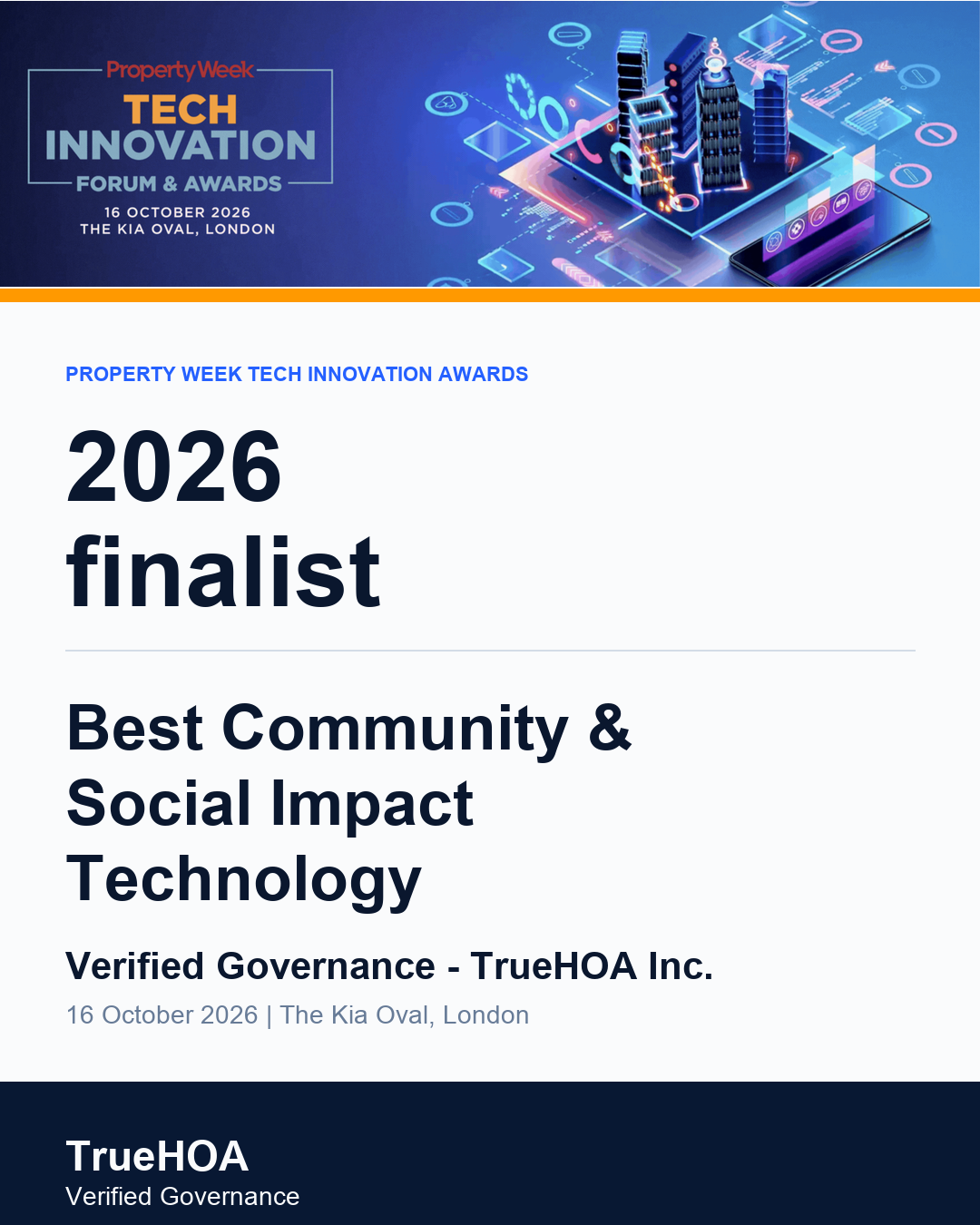
TrueHOA Inc. is taking Verified Governance® to London as a finalist in the Best Community & Social Impact Technology category at the Property Week International Tech Innovation Awards 2026. It is a major international milestone for a US-based company. Verified Governance® gives community decisions a clear, auditable and provable record: ballots, quorum, votes, timestamps and final outcomes. It helps managers run a defensible process, boards stand behind the outcome, and homeowners make their voices heard in the future of their community.
HOA Fees Are on the Rise, and the Twin Cities Has Among the Highest
The Minneapolis/St. Paul Business Journal features TrueHOA's national analysis of how HOA fees compound over time, finding that every $100 per month in fees capitalizes to roughly $20,000 in long-term cost. Founder Jonathan Gropper, JD, breaks down the highest-cost metros, noting that New York's $558 median fee alone represents about $112,000 of home price a buyer effectively gives up. TrueHOA's data reinforces why transparent, accountable HOA governance is becoming a bigger part of the home-buying conversation.
Fast Company covers TrueHOA as the first platform to bring independent verification to HOA elections — examining how 370,000 associations with no audit trail became a $5–10 billion liability, and why verified governance is becoming a due-diligence standard in housing.

HousingWire covers how outdated HOA governance practices are creating hidden financial risk for homebuyers and the agents who represent them. TrueHOA founder Jonathan Gropper, JD, explains why verified elections are becoming a due-diligence standard in real estate transactions.
A new TrueHOA analysis quantifies an invisible legal cost center buried inside 370,000 separate HOA budgets — and launches the first cryptographically verified election standard for community associations.
The VGS certification gives community leaders a practical, credential-backed path to implementing verifiable election and voting practices — free of charge.
A data-driven review of how HOAs operate, how quickly the sector is expanding, and what today's numbers mean for community governance, elections, and management.
The only person who checks HOA election results is usually the HOA. That gap ends now.
That gap has created mistrust, disputes, and an undercovered governance story in American housing. TrueHOA is the first platform to change it — making HOA elections independently verifiable, auditable, and defensible.
America has 370,000 HOAs and almost none can independently prove how they voted. Until now.
America has 370,000 homeowner associations and almost none can independently prove how they voted. Paper ballots. Email votes. Proxy chains. Room counts. These are not verifiable voting systems. They are liability generators — and when a vote is challenged, the result can rarely be proven.
TrueHOA makes HOA elections independently verifiable, more resistant to tampering, and easier to defend with a clear audit trail — reducing the kinds of disputes that cost homeowners and associations enormous time and money.
A Florida condo association ran a normal election. Three board seats. 147 units. Results by Friday.
By Monday, the lawyers were involved. Missing ballots. Duplicate ballots. Old addresses. The community could not prove how it voted.
Eighteen months and $186,000 in legal fees later, a court solved what TrueHOA could have prevented.
Trust fails. Proof doesn't.
HOA elections have been running on the honor system for decades. When someone challenges the result, there is often nothing concrete to show them. TrueHOA changes that.
Jonathan Gropper, JD — Founder, TrueHOAStory Angles by Beat
HOA disputes can suppress property values and deter buyers. Verified governance becomes a due-diligence signal. Boards that can prove how they run are more credible to buyers, lenders, and owners.
Paper ballots and opaque e-voting leave boards exposed when results are challenged. TrueHOA creates audit trails that are clearer, stronger, and easier to review in any legal proceeding.
Over 77 million Americans live under a form of local governance that rarely has strong accountability infrastructure. TrueHOA applies cryptographic verification to community decision-making.
Homeowners pay fees and live under rules shaped by elections they often cannot verify. That makes voting disputes and process opacity a genuine consumer issue.
The problem is not only fraud. It is opacity. A system that cannot reliably prove its own outcomes is a system that will always generate disputes.
Jonathan Gropper, JD — Founder, TrueHOAKey Facts for Your Story
- 01TrueHOA uses blockchain-backed cryptographic verification so each ballot is delivered, cast, and counted through a clear, independently reviewable audit trail.
- 02Built for electronic signature and recordkeeping frameworks under HOA election compliance needs in mind across all 50 states.
- 03The community sees who voted. No one sees how. The blockchain proves it independently. Proof. Not trust.
- 04Communities can run elections, budget approvals, and policy votes through TrueHOA at the annual meeting.
- 05Pricing: $0.50 per door per month. No setup fees. Available now. For $6 per door per year, communities eliminate the single largest source of HOA legal exposure.
HOA lawsuits are six-figure, multi-year affairs that not only destroy equity — they destroy communities. For $6 per door per year, TrueHOA solves that.
Jonathan Gropper, JD — Founder, TrueHOA
Jonathan Gropper is the founder of TrueHOA, a JD, and a U.S. Department of State Fulbright Specialist focused on AI and governance. His work centers on verified governance, institutional trust, and systems designed to make important decisions more auditable and accountable. He is available for interview and expert commentary across real estate, legal, civic technology, and consumer protection beats.